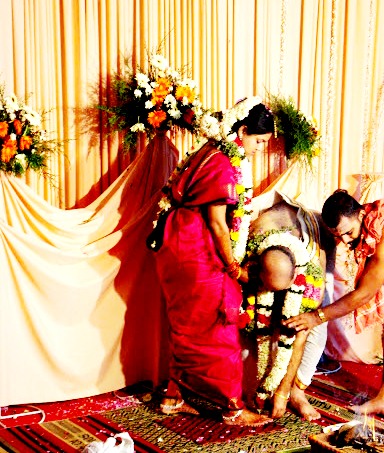
Excerpt from the
NOTES ON THE ARYAN SOCIETY by Dr. Babasaheb Ambedkar
Let us now take the Devas[f1]. The Devas were a powerful and most licentious community. They even molested the wives of the rishis. The story of how Indra raped Ahalya the wife of Rishi Gautama is well known. But the immoralities they committed on the Aryan women were unspeakable. The Devas as a community appears to have established an over lordship over the Aryan community in very early times. This over lordship had become degenerated that the Aryan women had to prostitute themselves to satisfy the lust of the Devas. The Aryans took pride if his wife was in the keeping of a Deva and was impregnated by him. The mention is in the Mahabharata and in the Harivamsha of sons born to Arya women from Indra. Yama, Nasatya, Agni, Vayu and other Devas is so frequent that one is astounded to note the scale on which such illicit intercourse between the Devas and the Arya women was going on.
In course of time the relations between the Devas
and the Aryans became stablized and appear to have taken the form of feudalism.
The Devas exacted two boons'[f2] from the Aryans.
The first boon was the Yajna which were periodic feasts given by the Aryans to the Devas
in return for the protection of the Devas in their fight against the Rakshasas,
Daityas and Danavas. The Yajnas were nothing but feudal exactions of the Devas.
If they have not been so understood it is largely because the word Deva instead
of thought to be the name of a community is regarded as a term for expressing
the idea of God which is quite wrong at any rate in the early stages of Aryan
Society.
The second boon claimed by the Devas against the
Aryans was the prior right to enjoy Aryan woman. This was systematized at a
very early date. There is a mention of it in the Rig-Veda in X. 85.40.
According to it the first right over an Arya female was that of Soma second of
Gandharva, third of Agni and lastly of the Aryan. Every Aryan woman was
hypothecated to some Deva who had a right to enjoy her first on becoming puber.
Before she could be married to an Aryan she had to be redeemed by getting the
right of the Deva extinguished by making him a proper payment. The description
of the marriage ceremony given in the 7th Khandika of the 1st Adhyaya of the
Ashvalayan Grahya Sutra furnish the most cogent proof of the existence of the
system. A careful and critical examination of the Sutra reveals that at the
marriage three Devas were present, Aryaman,
Varuna and Pushan, obviously
because they had a right of prelibation over the bride. The first thing that
the bride-groom does, is to bring her near a stone slab and make her stand on
it telling her 'Tread on this stone, like a stone be firm. Overcome the
enemies; tread the foes down'. This means that the bridegroom does it to
liberate the bride from the physical control of the three Devas whom he regards
as his enemies. The Devas get angry and march on the bridegroom. The brother of
the bride intervenes and tries to settle the dispute. He brings parched gram
with a view to offer it the Angry Deva with a view to buy off their rights over
the bride. The brother then asks the bride to join her palms and make a hollow.
He then fills the hollow of her palm with the parched grain and pours clarified
butter on it and asks her to offer it to each Deva three times. This offering
is called Avadana. While the bride is
making this Avadana to the Deva the brother of the bride utters a statement
which is very significant. He says "This girl is making this Avadana to
Aryaman Deva through Agni. Aryaman should therefore relinquish his right over
the girl and should not disturb the possession of the bridegroom".
Separate Avadanas are made by the bride to the other two Devas and in their
case also the brother alters the same formula. After the Avadan follows the
Pradakshana round the Agni which is called SAPTAPADI after which the marriage
of the bride and bridegroom becomes complete valid and good. All this of course
is very illuminating and throw a flood of light on the utter subjection of the
Aryans to the Devas and moral degradation of Devas as well as of the Aryans.
Lawyers know that Saptapadi is the most essential
ceremony in a Hindu marriage and that without it there is no marriage at Law.
But very few know why Saptapadi has so great an importance. The reason is quite
obvious. It is a test whether the Deva who had his right of prelibation over
the bride was satisfied with the Avadana and was prepared to release her. If
the Deva allowed the bridegroom to take the bride away with him up to a
distance covered by the Saptapadi it raised an irrefutable presumption that the
Deva was satisfied with the compensation and that his right was extinguished
and the girl was free to be the wife of another. The Saptapadi cannot have any
other meaning. The fact that Saptapadi is necessary in every marriage shows how
universally prevalent this kind of immorality had been among the Devas and the
Aryans.
One does not know what to say of the scholar who first
translated the Sanskrit word Deva by
the English word God. It was the greatest blunder which has resulted in
confusion and has prevented a proper understanding of the social life of the
Aryans as revealed in the Vedic literature. That Deva was the name of a
community is beyond question. That Rakshas. Daityas. Danavas are also names of
different communities in the same manner as the words Arya and Dasyu are. must
also be accepted without question.
Whether the relations between the Devas and the Aryans
were of the nature of the feudal relations between the Lord and the Vellein has
not yet been investigated largely because the Devas are not considered as a
community of men. The boons claimed by the Devas from the Aryans are the same
as those claimed by the Lord from his Vellein. (1) First fruits and (2) Prima
Noctis.
Why SAPTAPADI has so great importance in Hindu marriage ???


Why SAPTAPADI has so great importance in Hindu marriage ???