Showing posts with label Aryans. Show all posts

Tuesday, June 14, 2011

SAPTAPADI AND ITS SIGNIFICANCE


Excerpt from the
NOTES ON THE ARYAN SOCIETY by Dr. Babasaheb Ambedkar

Posted by P,
Let us now take the Devas[f1]. The Devas were a powerful and most licentious community. They even molested the wives of the rishis. The story of how Indra raped Ahalya the wife of Rishi Gautama is well known. But the immoralities they committed on the Aryan women were unspeakable. The Devas as a community appears to have established an over lordship over the Aryan community in very early times. This over lordship had become degenerated that the Aryan women had to prostitute themselves to satisfy the lust of the Devas. The Aryans took pride if his wife was in the keeping of a Deva and was impregnated by him. The mention is in the Mahabharata and in the Harivamsha of sons born to Arya women from Indra. Yama, Nasatya, Agni, Vayu and other Devas is so frequent that one is astounded to note the scale on which such illicit intercourse between the Devas and the Arya women was going on.
In course of time the relations between the Devas and the Aryans became stablized and appear to have taken the form of feudalism. The Devas exacted two boons'[f2]  from the Aryans.                           
The first boon was the Yajna which were periodic feasts given by the Aryans to the Devas in return for the protection of the Devas in their fight against the Rakshasas, Daityas and Danavas. The Yajnas were nothing but feudal exactions of the Devas. If they have not been so understood it is largely because the word Deva instead of thought to be the name of a community is regarded as a term for expressing the idea of God which is quite wrong at any rate in the early stages of Aryan Society.
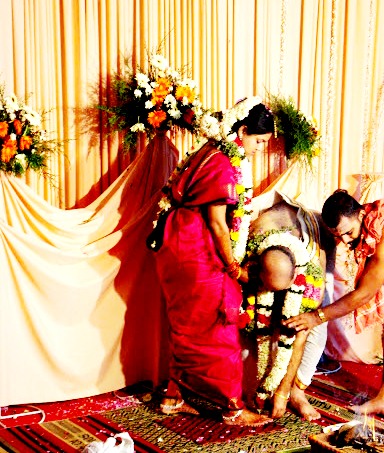
The second boon claimed by the Devas against the Aryans was the prior right to enjoy Aryan woman. This was systematized at a very early date. There is a mention of it in the Rig-Veda in X. 85.40. According to it the first right over an Arya female was that of Soma second of Gandharva, third of Agni and lastly of the Aryan. Every Aryan woman was hypothecated to some Deva who had a right to enjoy her first on becoming puber. Before she could be married to an Aryan she had to be redeemed by getting the right of the Deva extinguished by making him a proper payment. The description of the marriage ceremony given in the 7th Khandika of the 1st Adhyaya of the Ashvalayan Grahya Sutra furnish the most cogent proof of the existence of the system. A careful and critical examination of the Sutra reveals that at the marriage three Devas were present, Aryaman, Varuna and Pushan, obviously because they had a right of prelibation over the bride. The first thing that the bride-groom does, is to bring her near a stone slab and make her stand on it telling her 'Tread on this stone, like a stone be firm. Overcome the enemies; tread the foes down'. This means that the bridegroom does it to liberate the bride from the physical control of the three Devas whom he regards as his enemies. The Devas get angry and march on the bridegroom. The brother of the bride intervenes and tries to settle the dispute. He brings parched gram with a view to offer it the Angry Deva with a view to buy off their rights over the bride. The brother then asks the bride to join her palms and make a hollow. He then fills the hollow of her palm with the parched grain and pours clarified butter on it and asks her to offer it to each Deva three times. This offering is called Avadana. While the bride is making this Avadana to the Deva the brother of the bride utters a statement which is very significant. He says "This girl is making this Avadana to Aryaman Deva through Agni. Aryaman should therefore relinquish his right over the girl and should not disturb the possession of the bridegroom". Separate Avadanas are made by the bride to the other two Devas and in their case also the brother alters the same formula. After the Avadan follows the Pradakshana round the Agni which is called SAPTAPADI after which the marriage of the bride and bridegroom becomes complete valid and good. All this of course is very illuminating and throw a flood of light on the utter subjection of the Aryans to the Devas and moral degradation of Devas as well as of the Aryans.
Lawyers know that Saptapadi is the most essential ceremony in a Hindu marriage and that without it there is no marriage at Law. But very few know why Saptapadi has so great an importance. The reason is quite obvious. It is a test whether the Deva who had his right of prelibation over the bride was satisfied with the Avadana and was prepared to release her. If the Deva allowed the bridegroom to take the bride away with him up to a distance covered by the Saptapadi it raised an irrefutable presumption that the Deva was satisfied with the compensation and that his right was extinguished and the girl was free to be the wife of another. The Saptapadi cannot have any other meaning. The fact that Saptapadi is necessary in every marriage shows how universally prevalent this kind of immorality had been among the Devas and the Aryans.


One does not know what to say of the scholar who first translated the Sanskrit word Deva by the English word God. It was the greatest blunder which has resulted in confusion and has prevented a proper understanding of the social life of the Aryans as revealed in the Vedic literature. That Deva was the name of a community is beyond question. That Rakshas. Daityas. Danavas are also names of different communities in the same manner as the words Arya and Dasyu are. must also be accepted without question.

 Whether the relations between the Devas and the Aryans were of the nature of the feudal relations between the Lord and the Vellein has not yet been investigated largely because the Devas are not considered as a community of men. The boons claimed by the Devas from the Aryans are the same as those claimed by the Lord from his Vellein. (1) First fruits and (2) Prima Noctis. 

Why SAPTAPADI has so great importance in Hindu marriage ???


Monday, April 12, 2010

MORALITY OF THE RISHIS

Let us examine the morality of the rishis. What do we find? The first thing we find is the prevalence of bestiality among the rishis. Take the case of the rishi called Vibhandaka. In Adhyaya 100 of the Vana Parva of the Mahabharata it is stated that he cohabited with a female deer and that the female deer bore a son to him who subsequently became known as Rishi Shranga. In Adhyaya I as well as in 118 of the Adi Parva of the Mahabharata there is a narration of how Pandu the father of the Pandavas received his curse from the Rishi by name Dama. Vyas says that the Rishi Dama was once engaged in the act of coitus with a female deer in a jungle. While so engaged Pandu shot him with an arrow before the rishi was spent as a result of it Dama died. But before he died Dama uttered a curse saying that if Pandu ever thought of approaching his wife he would die instantly. Vyas tries to gloss this bestiality of the rishi by saying that the Rishi and his wife had both taken the form of deer in fun and frolic. Other instances of such bestiality by the rishis it will not be difficult to find if a diligent search was made in the ancient religious literature in India.
Another heinous practice which is associated with the rishis is cohabitation with women in the open and within the sight of the public. In Adhyaya 63 of the Adi Parva of the Mahabharata a description is given of how the Rishi Parashara had sexual intercourse with Satyavati, alias Matsya Gandha a fisherman's girl. Vyas says that he cohabited with her in the open and in public. Another similar instance is to be found in Adhyaya 104 of the Adi Parva. It is stated therein that the Rishi Dirgha Tama cohabited with a woman in the sight of the public. There are many such instances mentioned in the Mahabharata. There is, however, no need to encumber the record with them. For the word Ayonija is enough to prove the general existence of the practice. Most Hindus know that Sita, Draupadi and other renowned ladies are spoken of Ayonija. What they mean by Ayonija is a child born by immaculate conception. There is however no warrant from etymological point of view to give such a meaning to the Ayoni. The root meaning of the word Yoni is house. Yonija means a child born or conceived in the house. Ayonija means a child born or conceived outside the house. If this is the correct etymology of Ayonija it testifies to the practice of indulging in sexual intercourse in the open within the sight of the public.
Another practice which evidences the revolting immorality of the rishis in the Chandyogya Upanishad. According to this Upanishad it appears that the rishis had made a rule that if while they were engaged in performing a Yajna if a woman expressed a desire for sexual intercourse with the rishi who was approached should immediately without waiting for the completion of the Yajna and without caring to retire in a secluded spot proceeded to commit sexual intercourse with her in the Yajna Mandap and in the sight of the public. This immoral performance of the rishi was elevated to the position of a Religious observance and given the technical name of Vamadev- Vrata which was later on revived as Vama- Marga.
This does not exhaust all that one finds in the ancient sacredotal literature of the Aryans about the morality of the rishis. One phase of their moral life remains to be mentioned.
The ancient Aryans also seem to be possessed with the desire to have better progeny which they accomplished by sending their wives to others and it was mostly to the rishis who were regarded by the Aryas as pedigree cattle. The number of rishis who figure in such cases form quite a formidable number. Indeed the rishis seemed to have made a regular trade in this kind of immorality and they were so lucky that even kings asked them to impregnate the queens.

Wednesday, March 10, 2010

THE ANCIENT ARYAN WOMEN

The ancient Aryan women were sold. The sale of daughters is evidenced by the Arsha form of marriage. According to the technical terms used the father of the boy gave Go-Mithuna and took the girl. This is another way of saying that the girl was sold for a Go-Mithuna. Go-Mithuna means one cow and one bull which was regarded as a reasonable price of a girl. Not only daughters were sold by their fathers but wives also were sold by their husbands. The Harivamsha in its 79th Adhyaya describes how a religious rite called Punyaka-Vrata should be the fee that should be offered to the officiating priest. It says that the wives of Brahmins should be purchased from their husbands and given to the officiating priest as his fee. It is quite obvious from this that Brahmins freely sold their wives for a consideration.
That the ancient Aryans let their women on rent for cohabitation to others is also a fact. In the Mahabharata there is an account of the life of Madhavi in Adhyayas 103 to 123. According to this account Madhavi was the daughter of King Yayati. Yayati made a gift of her to Galawa. Galva who was a Rishi as a fee to a priest. Galva rented her
out to three kings in succession but to each for a period necessary to beget a son on her. After the tenancy of the third king terminated Madhavi was surrendered by Galva to his Guru Vishvamitra who made her his wife. Vishvamitra kept her till he begot a son on her and gave her back to Galva. Galva returned her to her father Yayati.
Polygamy and Polyandry were raging in the ancient Aryan society. The fact is so well known that it is unnecessary to record cases which show its existence. But what is probably not well known is the fact of promiscuity. Promiscuity in matters of sex becomes quite apparent if one were only to examine the rules of Niyoga which the Aryan name for a system under which a woman who is wedded can beget on herself a progeny from another who is not her husband. This system resulted in a complete state of promiscuity for it was uncontrolled. In the first place, there was no limit to the number of Niyogas open to a woman. Madhuti had one Niyoga allowed to her. Ambika had one actual Niyoga and another proposed. Saradandayani had three. Pandu allowed his wife Kunti four Niyogas. Vyusistasva was permitted to have 7 and Vali is known to have allowed as many as 17 Niyogas, II on one and 6 on his second wife. Just as there was no limit to the number of Niyogas so also there was no definition of cases in which Niyoga was permissible. Niyoga took place in the lifetime of the husband and even in cases where the husband was not overcome by any congenital incapacity to procreate. The initiative was probably taken by the wife. The choice of a man was left to her. She was free to find out with whom she would unite a Niyoga and how many times, if she chose the same man. The Niyogas were another name for illicit intercourse between men and women which might last for one night or twelve years or more with the husband a willing and a sleeping partner in this trade of fornication.
These were the manners and morals of common men in the ancient Aryan Society. What were the morals of the Brahmins? Truth to tell they were no better men than those of the common men. The looseness of the morals among the Brahmins is evidenced by many instances. But a few will suffice. The cases showing that the Brahmins used to sell their wives has already been referred to. I will give other cases showing looseness. The Utanka is a pupil of Veda (the Purohita of Janmejaya III). The wife of Veda most calmly requests Utanka to take the place of her husband and 'approach ' her for the sake of virtue. Another case that may be referred to in this connection is that of Uddalaka's wife. She is free to go to other Brahmins either of her own free will, or in response to invitations. Shwetketu is her son by one of her husband's pupils. These are not mere instances of laxity or adultery. These are cases of recognized latitudes allowed to Brahmin women. Jatila-Gautami' was a Brahmin woman and had 7 husbands who were Rishis. The Mahabharata says that the wives of the citizens admire Draupadi in the company of her five husbands and compare her to Jatila Gautami with her seven husbands. Mamata is the wife of Utathya. But Brahaspati the brother of Utathya had free access to Mamata during the life time of Utathya. The only objection Mamata once raises to him is to ask him to wait on account of her pregnancy but does not say that approaches to her were either improper or unlawful.
Such immoralities were so common among the Brahmins that Draupadi when she was called a cow by Duryodhana for her polyandry is said to have said she was sorry that her husbands were not born as Brahmins.

Thursday, February 25, 2010

ARYANS MARITAL RELATIONS OF MEN AND WOMEN


We may next proceed to consider the marital relations of men and women. What does history say? In the beginning there was no law of marriage among the Aryans. It was a state of complete promiscuity both in the higher and lower classes of the society. There was no such thing as a question of prohibited degrees as the following instances will show.
Brahma married his own daughter Satarupa. Their son was Manu the founder of the Pruthu dynasty which preceded the rise of the Aiksvakas and the Ailas.
Hiranyakashpu married his daughter Rohini. Other cases of father marrying daughters are Vashishtha and Shatrupa, Janhu and Jannhavi, and Surya and Usha. That such marriages between father and daughters were common is indicated by the usage of recognizing Kanin sons. Kanin sons mean sons born to unmarried daughter. They were in law the sons of the father of the girl. Obviously they must be sons begotten by the father on his own daughter
There are cases of father and son cohabiting with the same woman, Brahma is the father of Manu and Satarupa is his mother. This Satarupa is also the wife of Manu. Another case is that of Shradha. She is the wife of Vivasvat. Their son is Manu. But Shradha is also the wife of Manu thus indicating the practice of father and son sharing a woman. It was open for a person to marry his brother's daughter. Dharma married 10 daughters of Daksha though Daksha and Dharma were brothers. One could also marry his uncle's daughter as did Kasyapa who married 13 wives all of whom were the daughters of Daksha and Daksha was the brother of Kasyapa's father Marichi.
The case of Yama and Yami mentioned in the Rig-Veda is a notorious case, which throws a great deal of light on the question of marriages between brothers and sisters. Because Yama refused to cohabit with Yami it must not be supposed that such marriages did not exist.
The Adi Parva of the Mahabharata gives a genealogy which begins from Brahmadeva. According to this genealogy Brahma had three sons Marichi, Daksha and Dharma and one daughter whose name the genealogy unfortunately does not give. In this very genealogy it is stated that Daksha married the daughter of Brahma who was his sister and had a vast number of daughters variously estimated as being between 50 and 60. Other instances of marriages between brothers and sisters could be cited. They are Pushan and his sister Acchoda and Amavasu. Purukutsa and Narmada, Viprachiti and Simhika, Nahusa and Viraja, Sukra-Usanas and Go, Amsumat and Yasoda, Dasaratha and Kausalya, Rama and Sita; Suka and Pivari; Draupadi and Prasti are all cases of brothers marrying sisters.
The following cases show that there was no prohibition against son cohabiting with his mother. There is the case of Pushan and his mother Manu and Satrupa and Manu and Shradha. Attention may also be drawn to two other cases, Arjuna and Urvashi and Arjuna and Uttara. Uttara was married to Abhimanyu son of Arjuna when he was barely 16. Uttara was associated with Arjuna. He taught her music and dancing. Uttara is described as being in love with Arjuna and the Mahabharata speaks of their getting married as a natural sequel to their love affair. The Mahabharata does not say that they were actually married but if they were, then Abhimanyu can be said to have married his mother. The Arjuna Urvasi episode is more positive in its indication.
Indra was the real father of Arjuna. Urvashi was the mistress of Indra and therefore in the position of a mother to Arjuna. She was a tutor to Arjuna and taught him music and dancing. Urvasi became enamoured of Arjuna and with the consent of his father, Indra, approached Arjuna for sexual intercourse. Arjuna refused to agree on the ground that she was like mother to him. Urvashi's conduct has historically more significant than Arjuna's denial and for two reasons. The very request by Urvashi to Arjuna and the consent by Indra show that Urvashi was following a well established practice. Secondly, Urvashi in her reply to Arjuna tells him in a pointed manner that this was a well recognized custom and that all Arjuna's forefathers had accepted precisely similar invitations without any guilt being attached to them.
Nothing illustrates better than the complete disregard of consanguinity in cohabitation in ancient India than the following story which is related in the second Adhyaya of the Harivamsha. According to it Soma was the son of ten fathers—suggesting the existence of Polyandry—each one of whom was called Pralheta. Soma had a daughter Marisha—The ten fathers of Soma and Soma himself cohabited with Marisha. This is a case of ten grand-fathers and father married to a woman who was a grand-daughter and daughter to her husbands. In the same Adhyaya the story of Daksha Prajapati is told. This Daksha Prajapati who is the son of Soma is said to have given his 27 daughters to his father, Soma for procreation. In the third Adhyaya of Harivamsha the author says that Daksha gave his daughter in marriage to his own father Brahma on whom Brahma begot a son who became famous as Narada. All these are cases of cohabitation of Sapinda men, with Sapinda women.